
How Can Cultural IP Become an Immersive Experience?
5 min read
A recognisable name is not enough to make a good immersive experience. The strongest cultural IP may already contain extraordinary art, stories, characters or ideas. Turning that material into a physical attraction still requires a new creative question...
A recognisable name is not enough to make a good immersive experience.
The strongest cultural IP may already contain extraordinary art, stories, characters or ideas. Turning that material into a physical attraction still requires a new creative question:
What can an audience do here that they could not do through a book, screen, gallery label or archive?
That question sits at the centre of translating intellectual property into immersive entertainment.
Start with the reason to make it physical
An immersive adaptation should justify the journey.
Audiences can already access an enormous amount of cultural material digitally. Images, films, interviews, music, documents and virtual tours are available without leaving home.
A physical experience therefore needs to offer something different.
That might be scale. It might be spatial storytelling, shared participation, responsive technology, sound or the ability to move through a subject rather than consume it in a fixed order.
The aim isn't simply to make existing content bigger. It's to discover what becomes possible, and what story can be told, when the audience is physically present.
Find the world inside the IP
Some intellectual property is obviously spatial.
A fictional universe may contain recognisable locations. An artist may have a distinctive visual language. A historical figure may have a body of work spanning different periods and disciplines.
Other subjects require more interpretation.
Leonardo da Vinci is a useful example because his work extends far beyond a single famous painting. Art, anatomy, engineering, astronomy, invention and observation all provide routes into the same mind.
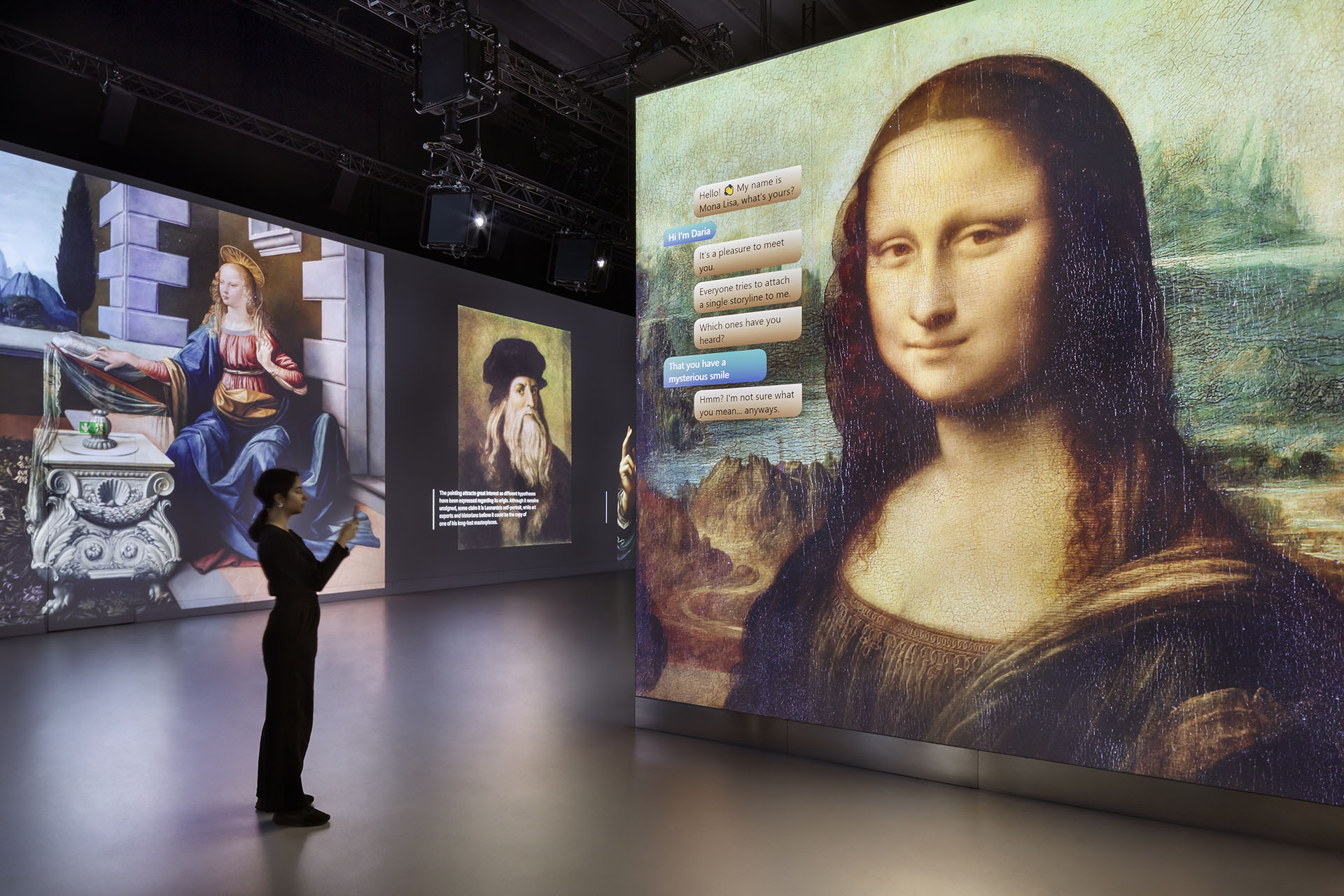
Da Vinci Genius uses that breadth as the basis for an interactive journey. The subject is not treated simply as a collection of images to project at scale. The experience invites visitors to engage with Leonardo's ideas through large-scale visuals, spatial sound and responsive interaction.
The underlying IP provides the world. The immersive design determines how an audience enters it.
Decide what must remain authentic
Immersive adaptation involves interpretation.
That makes creative governance important, particularly when the IP has cultural, artistic or historical significance.
Rights holders and producers need to establish which elements are fixed, which can be reinterpreted and what level of contextual accuracy the experience requires.
That can include visual assets, language, chronology, music, brand presentation, approved narratives and the way original works are represented.
The aim is not to prevent creative invention. It is to make sure invention serves the subject rather than distorting it.
This becomes especially important when an experience travels internationally. Local marketing and audience communication may change, while the core identity of the production needs to remain coherent.
Build interaction around the subject
Interactivity works best when it grows naturally from the IP.
A visitor should not be asked to touch, move or choose something simply to demonstrate that the installation contains technology.
The action should reveal something.
For an artist, that might mean exploring colour, composition or technique. For an inventor, it might mean experimenting with a mechanism. For a story-led property, it could mean influencing the environment or making a decision inside the narrative.
Da Vinci Genius includes responsive moments where visitors can engage with Leonardo's unfinished drawings and ideas. The participation is connected to curiosity and making, themes that belong to the subject itself.
That relationship is important.
The technology should help the audience understand or feel the IP differently.
Use technology as a medium, not the headline
Immersive experiences can involve projection, tracking, sensors, real-time graphics, spatial audio and other sophisticated systems.
Those tools are valuable, but they date quickly when technology itself becomes the entire proposition.
A stronger approach begins with the creative idea.
What should the audience feel? What should they discover? Where should their attention move? What role should they play?
The technical system can then be selected around those goals.
This also makes an experience more resilient. Individual technologies will evolve, but a strong story and clear audience relationship can survive technical updates.
Think about sound from the beginning
Visual spectacle receives much of the attention in immersive entertainment, but sound changes how an audience understands space.
It can direct attention, signal transitions, create intimacy or make a large environment feel overwhelming.
Music can also become part of the identity of the adaptation.
Da Vinci Genius uses an original score by GRAMMY-nominated producer Sasha, integrated with the visual and spatial journey. The sound is not simply background music added after the imagery has been completed. It is part of how the environment is experienced.
For rights holders, this is another reason to think beyond the obvious visual assets contained in the IP.
Design for real audiences
An immersive concept eventually has to become a place full of people.
That means the creative design needs to consider visitor behaviour.
How do people enter? What do they understand first? Can several people interact at once? What happens if someone chooses not to participate? Where do crowds form? How does the experience communicate what to do without constant staff intervention?
These are not purely operational questions.
They affect the creative experience.
A beautiful interaction that works for one person in a studio may fail when twenty people enter the room together. A narrative that makes sense to its creators may be unclear to someone encountering the subject for the first time.
Testing with real audiences is therefore part of translating IP into a physical format.
Consider whether the experience can travel
If the ambition is international, touring cannot be solved after the creative work is finished.
A production needs to understand which elements are essential and which can adapt.
Technical requirements, footprint, content systems, branding and quality control all affect whether an experience can move efficiently between venues.
Phoenix Immersive develops its productions around scalable deployment. Its current shows are offered across multiple footprints, allowing the same core production to work within different venue contexts.
For an IP owner, that can materially change the opportunity.
Instead of creating one highly bespoke installation tied to a single building, the experience can be designed as a format capable of reaching audiences across different markets.
Protect the thing people cared about in the first place
The temptation with immersive technology is to add more.
More projection. More interaction. More effects. More spectacle.
But cultural IP already has a reason people care about it.
The job of immersive adaptation is not to bury that beneath technology. It is to create a new route into it.
The most useful test is whether a visitor leaves with a stronger relationship to the subject.
If the experience has done that, the technology has served its purpose.
Have an IP or cultural property with immersive potential? Speak to Phoenix Immersive about developing or licensing interactive experiences for physical audiences.
Interested in licensing or hosting a Phoenix Immersive experience? Get in touch.