
Interactive vs Immersive Experiences: What Is the Difference?
4 min read
“Immersive” and “interactive” are often used as if they mean the same thing. They do not. An experience can be immersive without giving the audience any control. It can also be interactive without creating a convincing sense of immersion.
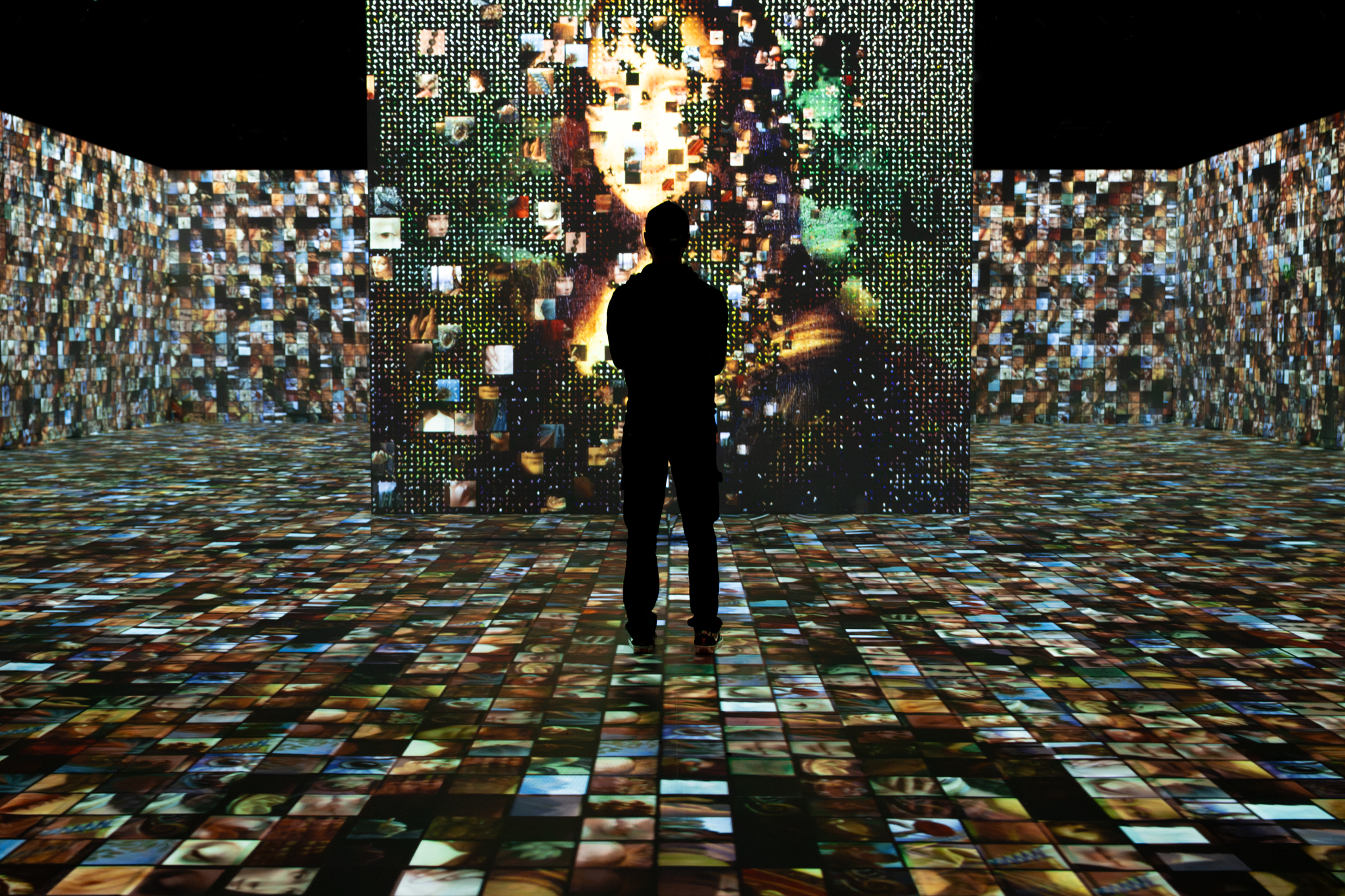
“Immersive” and “interactive” are often used as if they mean the same thing.
They do not.
An experience can be immersive without giving the audience any control. It can also be interactive without creating a convincing sense of immersion.
The distinction matters for audiences, venues and producers because it changes what people actually do once they enter the room.
What makes an experience immersive?
Immersion is about the visitor's sense of presence.
Instead of looking at a piece of content from the outside, the audience feels surrounded by it or situated within it. Scale, spatial sound, light, architecture, storytelling and movement can all contribute.
A projection environment can be immersive because imagery fills the visitor's field of view. A theatrical experience can be immersive because the audience moves through a fictional world. Virtual reality can create immersion by replacing much of the user's visual and auditory environment.
None of those formats necessarily requires the visitor to change what happens.
That is where interactivity becomes distinct.
What makes an experience interactive?
An interactive experience responds to the audience.
The input might be a touch, gesture, movement, choice, voice or another action. The important point is that the system receives something from the visitor and changes in response.
That response can be simple or complex.
A projected surface might react when someone touches it. A digital environment might follow the movement of a visitor across the floor. A narrative might change according to a decision.
Interactivity turns the visitor from a spectator into a participant.
Why the distinction matters
Imagine two rooms with floor-to-ceiling projection.
In the first, visitors enter and watch a beautifully produced sequence. The visuals and sound may be highly immersive, but the sequence continues in exactly the same way regardless of what the audience does.
In the second, the projected environment changes as people move. A visitor reaches towards an image and it responds. Another action triggers a different visual state.
Both rooms can be immersive.
Only the second is interactive.
That difference changes the audience's relationship with the content. Instead of simply receiving the work, the visitor becomes part of the mechanism through which it unfolds.
Interactivity should have a creative purpose
Adding sensors to a room does not automatically make an experience better.
The interaction needs to make sense within the subject and story.
If the audience is asked to wave at a wall purely because the technology can detect a hand, the interaction can feel like a demonstration. If that same gesture allows the visitor to explore an idea, alter an artwork or reveal something meaningful, it becomes part of the experience.
Phoenix Immersive's approach is built around this distinction.
In Da Vinci Genius, visitors do not simply watch large-scale imagery based on Leonardo da Vinci's work. Responsive surfaces allow them to interact with the environment, set flying machines in motion and complete unfinished drawings.
The interaction relates directly to a subject defined by experimentation, curiosity and invention.
That is more meaningful than adding participation after the creative concept has already been completed.
Responsive technology can make repeat visits less identical
A linear projection loop has a fixed sequence.
Visitors may notice different details on a second visit, but the underlying content remains the same.
Interactive systems introduce variability.
When a room responds to where people stand, what they touch or how they move, the precise result can change from one audience to another. The experience becomes partly dependent on the people inside it.
That does not require an infinite number of outcomes.
Even relatively bounded interaction can make visitors feel that their presence matters. The key is that the system visibly acknowledges them.
Interactivity can also change social behaviour
Immersive experiences are often shared with other people.
That creates another dimension to interaction.
A visitor may discover something because they see someone else trigger it. Groups may experiment together. Children and adults can approach the same responsive environment in different ways.
The room becomes a social space rather than a sequence that everyone consumes identically.
Designing for this requires care. Interactive elements need to work with multiple visitors, avoid creating unnecessary queues and make it reasonably clear that participation is possible.
The best interaction often feels intuitive
Visitors should not need a technical manual before they can engage.
Good interaction usually communicates its possibilities through design.
Movement, light, sound or visual cues can invite someone to approach a surface or try an action. The response then confirms that the system has noticed them.
This feedback loop is important.
If a visitor touches something and cannot tell whether anything happened, the technology quickly becomes frustrating. If the response is immediate and legible, curiosity encourages further exploration.
Interaction also needs to account for accessibility and different levels of confidence. Not everyone will want to perform dramatically in front of a room full of strangers. A strong experience can provide ways to participate without making interaction feel compulsory.
Immersion and interactivity work best together
Interactivity is not a replacement for storytelling, visual design or sound.
It is another tool.
A responsive wall in an otherwise incoherent environment will not create a strong experience. Equally, a beautifully designed immersive room can be compelling without complex interaction.
The opportunity comes when the elements support each other.
Story gives the audience a reason to care. Spatial design gives them somewhere to be. Sound and visuals shape the atmosphere. Interaction gives them agency within it.
For Phoenix Immersive, that relationship is central to the product: the audience is not simply placed inside a large image. Their participation is designed into the show.
That is the clearest difference between something that surrounds an audience and something that responds to them.
Explore Phoenix Immersive's interactive productions and see how participation is designed into the experience from the outset.
Interested in licensing or hosting a Phoenix Immersive experience? Get in touch.